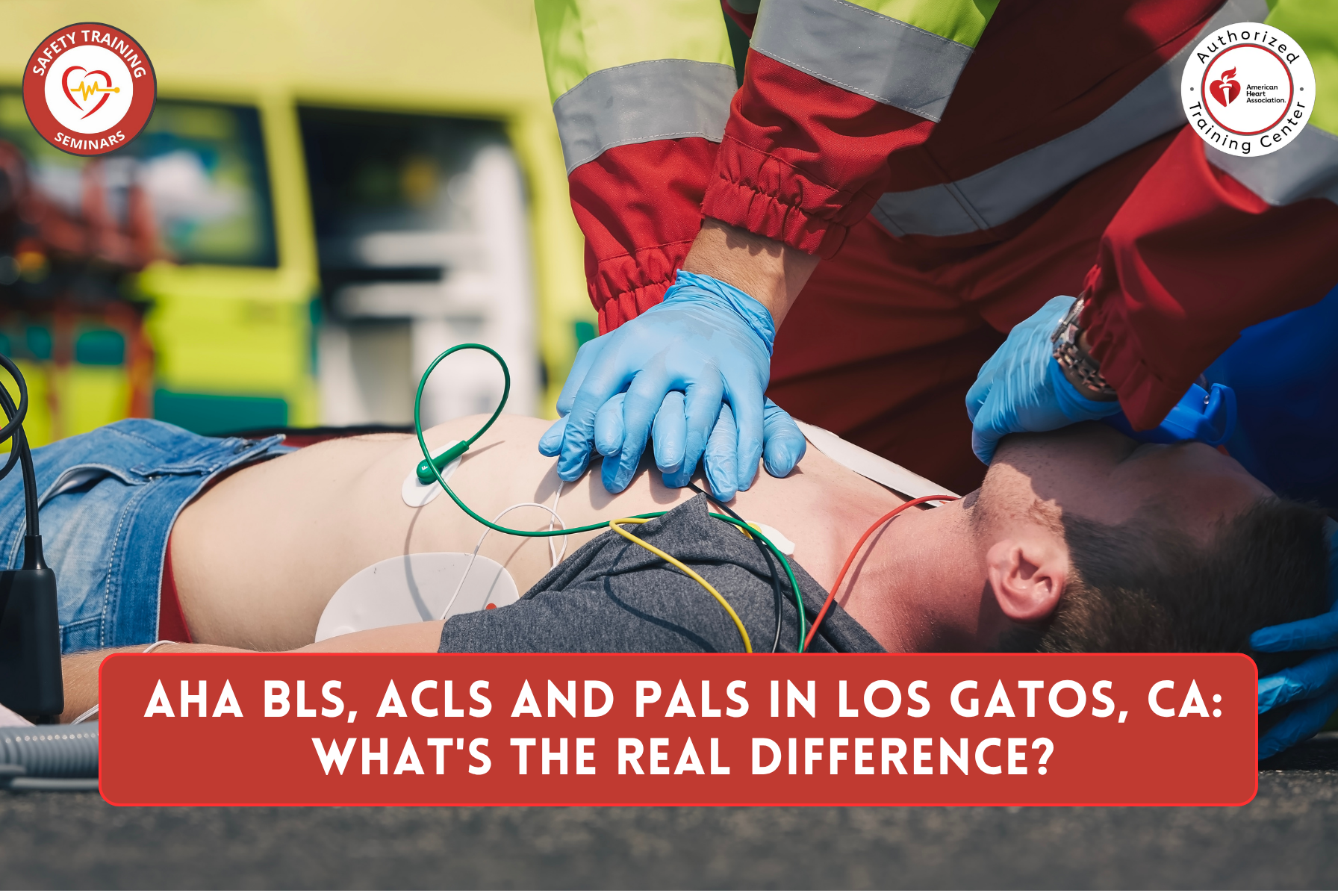
If your employer, school, or clinical program has told you to complete an American Heart Association course, BLS, ACLS, and PALS can sound confusingly similar. They all involve emergency response, but they are designed for different clinical situations and levels of responsibility.
For most healthcare workers in Los Gatos, CA, BLS is the foundation. ACLS adds advanced assessment and treatment for adult cardiovascular emergencies, while PALS focuses on serious emergencies involving infants and children. The right course depends on the patients you care for and the credential your employer, school, or licensing organization actually requires.
Key Takeaway: A BLS CPR Certification Course is commonly the starting point for healthcare professionals and students. ACLS and PALS are advanced courses for providers involved in adult or pediatric emergency management, so the three credentials should not be treated as interchangeable.
BLS, ACLS and PALS Solve Different Problems
The simplest comparison is to ask: Who is the patient, and what level of care are you expected to provide?
BLS, or Basic Life Support, focuses on recognizing life-threatening emergencies, performing high-quality CPR, using an automated external defibrillator (AED), providing ventilations, and working effectively during resuscitation. The American Heart Association describes BLS as training for healthcare professionals and trained responders in prehospital and in-facility settings.
ACLS, or Advanced Cardiovascular Life Support, builds on BLS. It is intended for healthcare professionals who direct or participate in the management of cardiac arrest, stroke, and other cardiopulmonary emergencies.
PALS, or Pediatric Advanced Life Support, focuses on pediatric patients. It prepares healthcare professionals to assess and respond to serious respiratory, circulatory, and cardiac emergencies in infants and children.
The courses overlap in teamwork and resuscitation skills, but their clinical focus differs. ACLS does not replace PALS, and an advanced course may not replace a separate BLS requirement.
Who Usually Needs a BLS CPR Certification Course?
BLS is often relevant for nurses, nursing students, medical assistants, EMTs, dental professionals, therapists, and others who may be expected to respond to a cardiac or respiratory emergency as part of their work or training.
The AHA identifies healthcare professionals, trained first responders, and people enrolled in healthcare training programs as typical BLS participants. It also advises students to confirm the exact course their employer requires before enrolling.
Teachers, childcare providers, fitness professionals, parents, or workplace employees may instead need CPR or First Aid training. A hospital requirement does not automatically apply to nonclinical settings.
If you are comparing South Bay options, review the course description rather than choosing only by the words “CPR certification.” You can also review CPR, BLS, ACLS and PALS course options in San Jose for nearby location information.
When ACLS Becomes the More Relevant Credential
ACLS is designed for professionals involved in managing adult cardiac arrest and other serious cardiovascular or cardiopulmonary emergencies. The AHA lists emergency response, emergency medicine, intensive or critical care, and surgery among settings where ACLS may be relevant.
ACLS is better understood as an advanced adult-emergency course built on BLS, not simply “a harder CPR class.” If your employer says “ACLS required,” confirm whether current BLS is also required separately because organizations can set their own documentation rules.
PALS Is Advanced Training for Pediatric Emergencies
PALS serves a different patient population. It is intended for healthcare professionals who may need to recognize and manage serious deterioration in infants and children.
The AHA describes PALS as training that includes systematic pediatric assessment, basic life support, treatment algorithms, and team dynamics. Clinical situations can include respiratory emergencies, shock, arrhythmias, and cardiopulmonary arrest.
PALS may be especially relevant in pediatric, emergency, or critical-care settings. Adult-focused providers may need ACLS without PALS, while pediatric roles may require PALS; some positions may require both.
Readers from the west side of Santa Clara County can also review the Saratoga CPR, BLS, ACLS and PALS course page when comparing nearby options.
Do You Need BLS Before ACLS or PALS?
BLS skills form the foundation for advanced resuscitation training. The AHA explicitly describes ACLS as building on BLS, and PALS also incorporates basic life support within pediatric emergency care.
Documentation policies vary. For a hospital job, nursing program, clinical rotation, or new position, check the written requirement for the exact course name and whether multiple credentials must be current.
Course Format and Hands-On Skills: What to Confirm
The AHA offers BLS in classroom and blended-learning formats. In blended BLS, online learning is paired with a hands-on skills session; the online portion alone is not the full blended course.
ACLS and PALS also involve skills-based learning. Before registering, confirm the hands-on requirements and what documentation is issued after successful completion.
For local students, this is also the time to verify current availability and course type. If you are considering a location farther north, compare the Sunnyvale CPR and advanced life support course information before choosing a center.
Choosing a Course in Los Gatos and the South Bay
Los Gatos serves people with very different training needs across the South Bay. A nurse from San Jose may be renewing BLS and ACLS, while a nursing student from Santa Clara or Mountain View may be completing a school requirement for the first time. A pediatric provider may need PALS, while a teacher or caregiver may need CPR and First Aid instead.
Readers coming from Saratoga, Sunnyvale, Palo Alto, Morgan Hill, Mountain View, San Jose, or Santa Clara should start with the requirement in writing and then match it to the correct course.
Safety Training Seminars offers local training at 236 North Santa Cruz Ave, Suite 246, Los Gatos, CA 95030. Before enrolling, review the relevant course information and confirm that it matches your employer, school, or professional requirement. Those comparing nearby locations can also review Palo Alto CPR, BLS, ACLS and PALS training information.
Frequently Asked Questions
Is BLS the same as regular CPR training?
No. BLS includes CPR and AED skills, but it is designed for healthcare professionals, trained responders, and healthcare students. A general CPR or CPR/First Aid course may be a better fit for some teachers, caregivers, fitness staff, or workplace teams. Use the exact requirement provided by your employer or school.
If I take ACLS in Los Gatos, do I still need BLS?
Possibly. ACLS builds on BLS skills, but employers and schools may require separate current documentation for both. If your job, onboarding checklist, or clinical program lists BLS and ACLS separately, do not assume one replaces the other. Confirm with the organization requesting the credential.
Who should consider PALS training near Los Gatos?
PALS is most relevant for healthcare professionals whose work may involve infants or children with serious respiratory, circulatory, or cardiac emergencies. Pediatric, emergency, and critical-care roles are common examples. If you are unsure, ask your employer, department, school, or licensing body before registering.
Can students from Saratoga, San Jose, or Santa Clara attend training in Los Gatos?
Students from nearby communities can consider the Los Gatos location, but should verify availability and registration details for the credential they need. Match the course to the requirement first, then choose a location.
Is an online-only BLS course enough for a healthcare job?
Do not assume that it is. The AHA offers blended BLS in which online learning is followed by a hands-on skills session. Employer and school acceptance can vary, so confirm both the required course and completion format before relying on an online option.
The Bottom Line for Los Gatos Students and Healthcare Professionals
BLS, ACLS, and PALS are connected, but they are not interchangeable. BLS provides the core CPR, AED, ventilation, and team-response foundation for healthcare settings. ACLS extends that foundation into advanced adult cardiovascular emergencies, while PALS applies advanced assessment and resuscitation principles to infants and children.
If you need training in Los Gatos, start with the exact wording from your employer, school, clinical program, or licensing organization. Then compare the course description and completion requirements before registering. Safety Training Seminars can be one local option to review for BLS, ACLS, PALS, CPR, and First Aid training. Your next step is to check the most relevant course-location page for current course type, location information, availability, and registration details.